
Appelez-nous
:
+8618925446207
Envoyez-nous un courriel
:
marketing@databeyond.com
 English
 Français
 Deutsch
 Español
 日本語
日本語 中文
中文




Is the equipment operating normally? What is today’s production output? Is product quality stable? How is the business performing this month?
For many recycling plants, answering these seemingly simple questions often involves multiple areas of management, including production, equipment, personnel, and finance. Managers may need to check different systems, review multiple reports, and rely on information consolidated across several levels before they can obtain a complete picture.
In recent years, as artificial intelligence, intelligent equipment, and automation technologies have become increasingly integrated into the recycling industry, more and more traditional manual sorting tasks have been replaced by intelligent systems. However, when it comes to factory management, activities such as personnel inspection, equipment maintenance, production reporting, quality analysis, and operational accounting still rely heavily on human experience and coordination.
As production lines become increasingly intelligent, factory management must evolve as well.
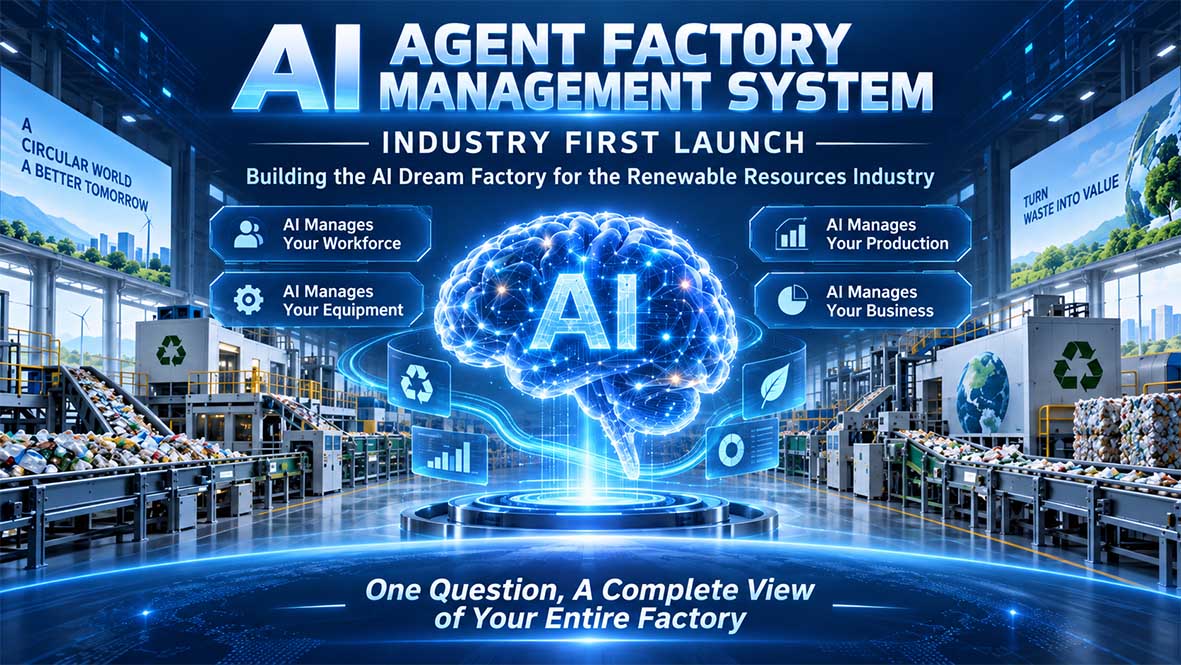
Against this backdrop, DataBeyond has launched its AI Agent Factory Management System, extending AI capabilities from intelligent sorting on the production line to production management, equipment management, and operational decision-making, enabling artificial intelligence to become deeply involved in the day-to-day operation of recycling plants.
The DataBeyond AI Agent Factory Management System is not simply another data dashboard, nor is it merely a digital display of existing production information.
By connecting data across personnel, equipment, production, quality, and operations, the system gives AI the ability to continuously perceive factory conditions, analyze information, identify abnormalities, issue alerts, and respond intelligently to management questions.
Managers can ask questions about factory operations directly in natural language, while the AI analyzes real-time production data and quickly provides relevant answers.
In the past, factory management relied on people searching for data, reviewing reports, and making judgments. Today, AI is beginning to participate directly in information retrieval, problem analysis, and management decision-making.
Failure to wear safety helmets, smoking in restricted areas, improper operations, employees leaving their posts, unauthorized personnel entering the facility…
Traditional factory safety management relies heavily on manual inspections. This is labor-intensive and can also be limited by staff availability, attention, and the physical scale of the facility.
With AI-powered visual recognition, the system can continuously identify personnel behavior on site, detect violations and abnormal situations, issue timely alerts, and automatically generate relevant records.
Tasks that previously required repeated manual patrols can now be supported by continuously operating AI recognition, improving both management efficiency and workplace safety.
AI identifies on-site abnormalities in real time, moving safety management from passive inspection to proactive alerting.
Recycling plants often operate large numbers of machines across long and complex production processes. Problems such as material blockages, abnormal temperatures, unusual water levels, or equipment failures can affect production efficiency and potentially result in costly downtime.
The DataBeyond AI Agent enables 24/7 continuous monitoring of equipment operating conditions. Combined with 2D process visualization and 3D digital production-line models, the system provides real-time visibility into equipment and process performance.
When an abnormal condition occurs, the system can quickly identify the issue and assist in locating the relevant machine or process stage, providing data support for maintenance, adjustment, and production scheduling.
Equipment management is therefore shifting from manual machine-by-machine inspections toward real-time monitoring, centralized visibility, and intelligent alerts.
How much was produced today? Is the yield stable? Which batch showed abnormal fluctuations? Is production efficiency within the normal range?
The DataBeyond AI Agent connects data throughout the entire production process, from raw material intake and processing to quality inspection and finished-product shipment. Key production data is automatically collected and continuously stored.
Based on this data, the AI can further analyze production output, product quality, yield, batch differences, and production abnormalities, while automatically generating daily, weekly, and monthly production reports.
Work that previously depended heavily on manual statistics, spreadsheets, and reporting is gradually shifting toward automatic data collection, intelligent analysis, and data-driven management.
Production data is continuously captured, making factory operations more transparent than ever before.
For factory operators, management ultimately comes down to cost, efficiency, and profitability.
Traditionally, raw material purchasing, labor costs, energy consumption, production data, and sales information have been distributed across different parts of the business. Many factories can only gain a relatively complete understanding of their operating performance after monthly financial reconciliation.
The DataBeyond AI Agent connects production and operational data, integrating key information including raw material costs, labor costs, energy consumption, production output, inventory, and sales.
Managers can view and analyze how much raw material was consumed, how much was produced that day, how much energy was used, and how finished products are selling—all within a unified system.
This changes factory management from “calculating the numbers at the end of the month” to “knowing today’s profit and loss today,” enabling faster and more informed business decisions.
“How much did we produce today?”
“Which machine is operating abnormally?”
“What is today’s yield?”
“How is the business performing this month?”
“Why did production costs increase today?”
In the past, answering these questions often required contacting different departments, accessing multiple systems, and comparing several reports.
Today, an AI digital agent can analyze data across personnel, equipment, production, quality, and operations, and provide direct answers through natural-language interaction.
This represents a fundamental shift in the way factories are managed.
In the past, managing a factory meant finding the right people, locating the right reports, and searching for the right data.
In the future, managers can simply ask AI first.
For years, DataBeyond has been driving the adoption of artificial intelligence across recycling production lines, using AI-powered optical sorting technologies to identify, analyze, and sort different types of recyclable materials.
Now, AI is moving beyond individual machines and into the factory management system itself.
In the future, AI optical sorters will handle intelligent sorting, embodied intelligent robots will perform on-site operations, and AI agents will manage production, equipment, and business operations.
Together, intelligent equipment, robots, and AI management systems will form a new generation of highly integrated smart factories.
Through the coordinated operation of multiple intelligent systems, recycling plants can further reduce their dependence on manual inspections, manual reporting, and individual experience, while accelerating the transition toward automation, digitalization, and intelligent operation.
This is the AI Dream Factory for the recycling industry that DataBeyond is building.
From using AI to sort a single piece of waste to using AI to manage an entire recycling plant.
DataBeyond continues to expand artificial intelligence from individual equipment capabilities to factory-wide intelligence, enabling AI to participate directly in production, management, and operational decision-making while creating a new technological pathway for the intelligent transformation of the recycling industry.
 IPv6 RÉSEAU PRIS EN CHARGE
Laisser un message
Numériser vers Wechat :

Numériser vers WhatsApp :