
Appelez-nous
:
+8618925446207
Envoyez-nous un courriel
:
marketing@databeyond.com
 English
 Français
 Deutsch
 Español
 日本語
日本語 中文
中文




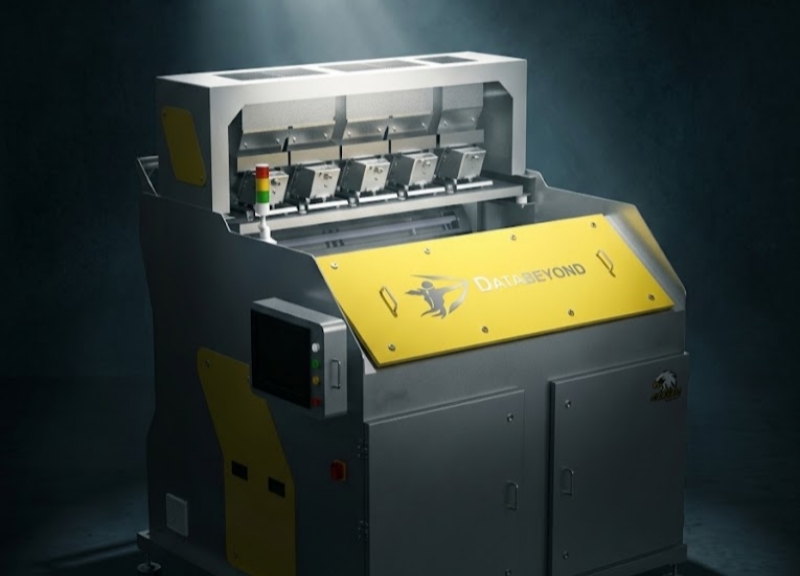
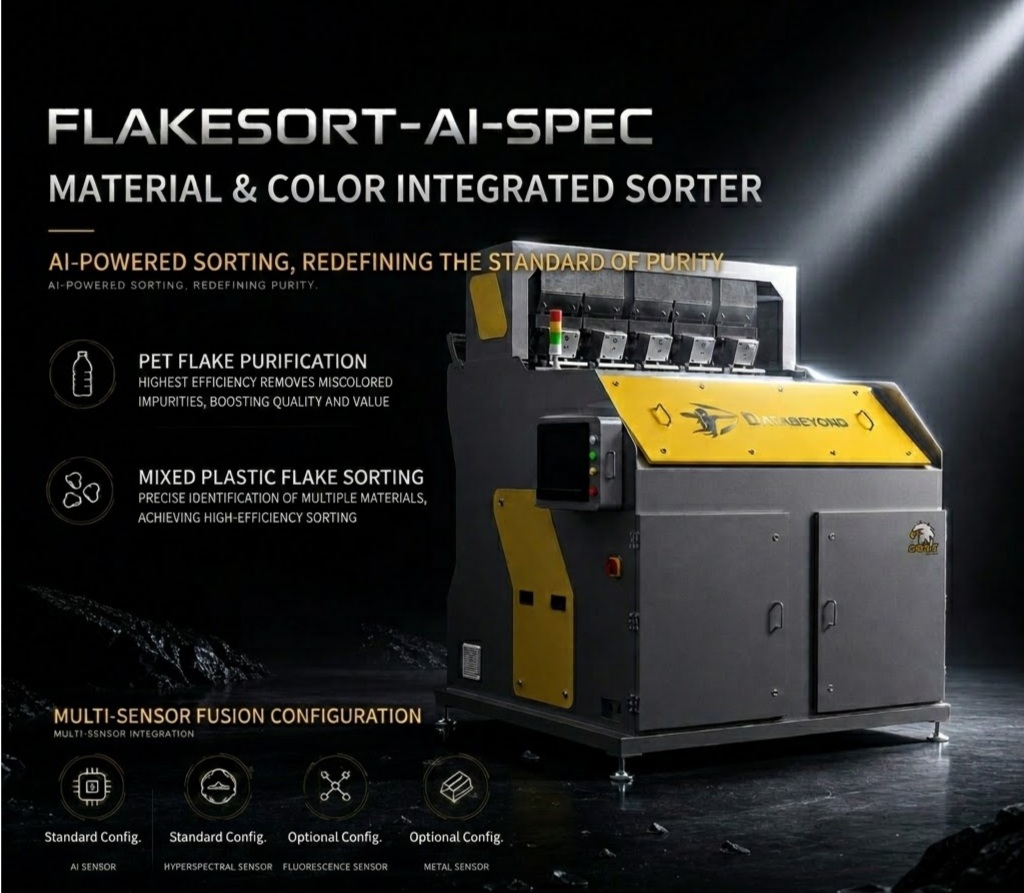
Lors du salon CHINAPLAS 2026, DataBeyond a officiellement dévoilé FLAKESORT-AI-SPEC. Grâce à l'intégration de la technologie hyperspectrale 256 bandes et d'algorithmes d'apprentissage profond basés sur l'intelligence artificielle, cet équipement révolutionnaire résout le problème technique persistant du tri simultané des matériaux et des couleurs. Le système permet l'intégration de processus multi-étapes au sein d'une seule unité, réduisant ainsi considérablement les coûts d'exploitation (OPEX) et les dépenses d'investissement (CAPEX) des entreprises de recyclage du plastique.
Défis de l'industrie : le compromis « matériau contre couleur »
Dans le recyclage haut de gamme des plastiques (comme le recyclage bouteille-à-bouteille ou la récupération des plastiques techniques), la pureté du tri détermine la valeur supérieure de la résine recyclée. Le secteur est confronté à deux principaux obstacles :
●Étapes de traitement redondantes : Les capteurs infrarouges proches (NIR) classiques identifient uniquement le type de matériau. Pour trier par couleur, les opérateurs doivent connecter en série des trieuses de couleurs indépendantes, ce qui engendre des installations volumineuses, une forte consommation d'énergie et une maintenance complexe.
● Points aveugles en matière d'identification : La technologie NIR traditionnelle à 3 bandes peine à traiter les paillettes vieillies et les mélanges de même couleur mais de matériaux différents (par exemple, PC/PS/ABS). Il en résulte des niveaux de pureté inférieurs, ne répondant pas aux normes de remplacement pour les matériaux vierges.
FLAKESORT-AI-SPEC : Quatre technologies clés définissent le tri de nouvelle génération
1. Hyperspectral 256 bandes + IA : Détection unifiée des matériaux et des couleurs
Le système FLAKESORT-AI-SPEC intègre un capteur hyperspectral linéaire à 256 bandes haute vitesse, développé en interne. Contrairement aux capteurs traditionnels à points d'échantillonnage limités, cette technologie capture les signatures spectrales à l'échelle moléculaire. Grâce à l'apprentissage profond de l'IA, le système exécute trois tâches en une seule passe :
●Identification multi-matériaux : Compatible avec plus de 100 polymères, dont le PP, le PE, le PET, l'ABS, le PS, le PC, le PA et le PMMA.
●Tri des couleurs ultra-fin : Permet de distinguer le transparent, le bleu clair, le blanc et diverses couleurs variées.
●Élimination des contaminants : Des capteurs de fluorescence et de métaux optionnels permettent d'identifier et d'éjecter les particules métalliques et les flocons vieillis.
2. Tri flexible : conception de canaux à plaque pleine non compartimentés physiquement
Les trieuses traditionnelles utilisent des canaux physiques fixes, ce qui complique les changements de produits. DataBeyond utilise une conception flexible et intégrée sur toute la surface. Les utilisateurs peuvent redéfinir les fonctions des canaux via des préréglages logiciels sans modification matérielle, permettant ainsi une commutation instantanée entre le traitement de petits lots de plastiques techniques et la purification de PET à grande échelle.
3. Couverture complète : des plastiques post-consommation aux plastiques techniques
Dotée d'une base de données de matériaux exhaustive, l'unité prend en charge :
●Tri positif : Extraction de matériaux cibles de haute pureté (par exemple, ABS de haute pureté à partir de DEEE/déchets électroniques).
●Purification négative : Éliminer toutes les impuretés autres que le PET dans les lignes de lavage des flocons de PET afin d'obtenir une qualité alimentaire.
4. Débit à l'échelle industrielle : maximiser le retour sur investissement
Disponible en modèles de 3 à 9 tonnes par heure, la FLAKESORT-AI-SPEC intègre plusieurs procédés dans une seule machine. Elle permet ainsi aux clients de réduire l'emprise au sol de leurs installations de 30 % et leur consommation d'énergie de 20 %, accélérant considérablement le retour sur investissement.
Valeur stratégique : Accélérer la transition vers une économie circulaire mondiale
Le lancement de FLAKESORT-AI-SPEC offre aux recycleurs de plastique une feuille de route commerciale plus compétitive :
●Prime produit accrue : L’obtention d’une pureté quasi-vierge favorise le remplacement haut de gamme, aidant ainsi les marques à respecter leurs engagements en matière de contenu recyclé.
●Barrières à l’entrée sur le marché réduites : Sa conception compacte et intégrée permet aux petites et moyennes installations de recyclage d'accéder à des capacités de tri haut de gamme.
●Empreinte environnementale réduite : Une meilleure efficacité du tri permet de réduire les déchets mis en décharge, contribuant ainsi directement aux objectifs mondiaux de réduction des émissions de carbone.
Leader mondial du tri intelligent, DataBeyond exploite des milliers d'unités pilotées par l'IA à travers le monde. Nous nous engageons à utiliser cette technologie pour valoriser au maximum chaque kilogramme de déchets.
 IPv6 RÉSEAU PRIS EN CHARGE
Laisser un message
Numériser vers Wechat :

Numériser vers WhatsApp :