
Appelez-nous
:
+8618925446207
Envoyez-nous un courriel
:
marketing@databeyond.com
 English
 Français
 Deutsch
 Español
 日本語
日本語 中文
中文




Face au durcissement constant de la réglementation européenne PPWR, des objectifs obligatoires de mélange de rPET de qualité alimentaire et des exigences d'approvisionnement en matériaux recyclés des marques nord-américaines, l'industrie mondiale du recyclage des bouteilles PET entre dans une phase d'« approvisionnement stable et de haute qualité ». Auparavant, de nombreuses entreprises de recyclage privilégiaient la réduction maximale des niveaux de contamination. Aujourd'hui, cependant, un nombre croissant de recycleurs européens et nord-américains sont confrontés à un défi plus pragmatique : comment éviter un tri excessif, source de pertes importantes de paillettes de bouteilles utilisables, tout en respectant les normes alimentaires de leurs clients et les exigences de conformité ? Pour le marché du recyclage de bouteilles à bouteilles à forte valeur ajoutée, la rentabilité à long terme ne repose pas uniquement sur la pureté, mais sur la capacité à maîtriser les fluctuations de qualité de manière constante, tout en maintenant un rendement élevé en paillettes et une efficacité opérationnelle globale optimale.
Dans les systèmes de recyclage de bouteilles en bouteilles, les bouteilles barrière, les bouteilles fluorescentes et les bouteilles anciennes constituent les trois principaux contaminants affectant la stabilité du rPET de qualité alimentaire. Si ces bouteilles ne peuvent être identifiées et éliminées efficacement, elles auront un impact direct sur le jaunissement des paillettes, l'apparition de taches noires, la stabilité de la viscosité et la consistance du produit final.

Bouteilles barrières Les bouteilles en PET recyclé sont largement utilisées dans l'emballage des produits alimentaires, des produits chimiques de consommation courante et des produits agrochimiques. Elles contiennent généralement des matériaux de barrière tels que l'EVOH et le nylon. Une fois intégrées au flux de recyclage du PET, une incompatibilité de leurs performances à l'état fondu peut entraîner l'apparition de points de cristallisation, de taches noires, de cratères et d'autres défauts de transformation dans les matériaux recyclés. Dans la production de rPET de qualité alimentaire, même des niveaux extrêmement faibles de contamination de la barrière peuvent entraîner la déclassification d'un lot entier et son inaptitude à accéder au marché haut de gamme du recyclage de bouteilles.
Bouteilles fluorescentes Ces bouteilles contiennent généralement des agents de blanchiment fluorescents et sont fréquemment utilisées dans les emballages de détergents, de pesticides et de produits médicaux. Sur le marché européen, les marques et les clients du secteur de l'emballage alimentaire renforcent leurs exigences en matière de contamination fluorescente. Dès que la contamination fluorescente dépasse le seuil acceptable, les entreprises risquent non seulement de perdre des commandes de produits alimentaires, mais aussi de faire face à des retours de produits et à des problèmes de certification.
Bouteilles vieillies Un autre problème, longtemps sous-estimé, concerne les bouteilles PET usagées. Exposées aux intempéries pendant de longues périodes, elles subissent une oxydation, un jaunissement et une dégradation de leur chaîne moléculaire. Incorporées aux flux de matières recyclées, ces bouteilles augmentent significativement le jaunissement des paillettes, réduisent leurs performances mécaniques et entraînent des fluctuations de qualité d'un lot à l'autre. Pour le soufflage de bouteilles et les applications de filament, les clients sont souvent plus préoccupés par l'incapacité à garantir une qualité constante d'un lot à l'autre que par des défauts occasionnels.
Pour maîtriser ces contaminants, de nombreux recycleurs de PET continuent d'ajouter des équipements de tri et de resserrer les paramètres de tri. Actuellement, de nombreuses usines utilisent plusieurs machines connectées en série pour détecter séparément les bouteilles barrière, les bouteilles fluorescentes et les bouteilles anciennes. Cette approche exige non seulement des investissements importants en équipements, une maintenance complexe et une grande surface au sol, mais elle accroît également les pertes de matière. Plus important encore, pour les bouteilles barrière transparentes dont l'étiquette a été retirée, les systèmes traditionnels présentent encore des taux de détection erronée relativement élevés. Parallèlement, de nombreux recycleurs relèvent continuellement les seuils de tri afin d'obtenir des niveaux de PPM plus bas. De ce fait, un grand nombre de paillettes de bouteilles conformes aux normes des clients sont également rejetées. Bien que les taux de contamination diminuent, le rendement en paillettes de bouteilles 3A est également considérablement réduit. Pour les lignes de production à grande échelle traitant des dizaines de milliers de tonnes par an, une perte de rendement de 1 à 3 % représente souvent des millions de RMB de pertes de profits. Dans de nombreux cas, cependant, ce que les clients exigent réellement, c'est simplement que la contamination reste dans la plage standard, plutôt que de tendre indéfiniment vers une « contamination zéro ».
Prenons l'exemple des paillettes pour bouteilles de qualité 3A ou de qualité filament : les normes de contrôle des paillettes jaunes et des paillettes fluorescentes imposent des limites physiques extrêmement strictes, exigeant généralement des valeurs PPM ≤ 2 000. Par conséquent, de plus en plus d'entreprises de rPET de qualité alimentaire commencent à se recentrer sur une question : comment maximiser le rendement tout en respectant les exigences de qualité ?
Pour relever ce défi industriel, Databeyond a lancé une solution de tri optique intelligent tridimensionnel pour les bouteilles barrières, fluorescentes et vieillies. Ce système intègre la reconnaissance spectrale des matériaux barrières, la détection de la fluorescence et des technologies de détection du vieillissement basées sur l'IA afin d'identifier et d'éliminer simultanément ces trois catégories de bouteilles à haut risque. Contrairement aux approches de tri traditionnelles « standardisées », le principe de Databeyond n'est pas de « tout éliminer », mais plutôt de « déterminer avec précision ce qui doit être éliminé et ce qui peut être accepté sans risque ». Par exemple, pour les flocons légèrement vieillis qui répondent encore aux exigences de performance mécanique, le système peut les identifier et les conserver avec précision, réduisant ainsi les pertes de matière inutiles tout en garantissant que le produit final reste conforme aux normes. De même, pour certains matériaux présentant une légère fluorescence qui n'affecte pas les spécifications alimentaires finales, le système peut éviter un tri excessif.
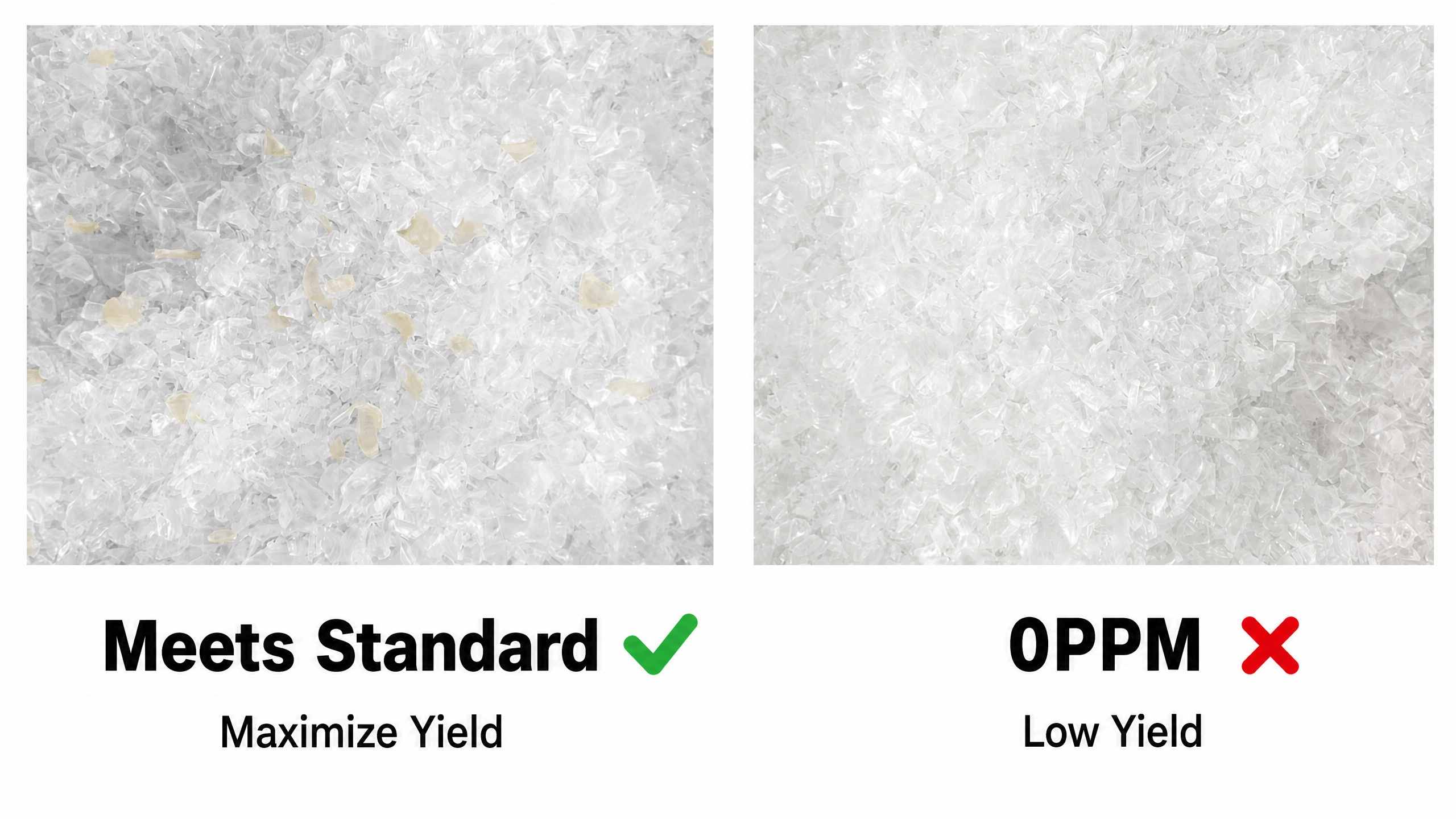
Le principal changement induit par cette approche est que les recycleurs de PET passent d'une logique de « taux de particules le plus bas » à une logique de « qualité plus stable et contrôlable et de rendement plus élevé ». En effet, sur le marché du rPET de qualité alimentaire, la rentabilité à long terme ne dépend pas du taux de particules le plus bas, mais de la capacité à respecter les normes des clients de manière constante tout en conservant davantage de paillettes de bouteilles à forte valeur ajoutée commercialisables.
À l'avenir, la concurrence sur le marché du rPET à haute valeur ajoutée se concentrera de plus en plus sur plusieurs atouts clés : la réduction des fluctuations de qualité, la stabilité des lignes de production, l'augmentation des rendements et la capacité à répondre durablement aux exigences du marché alimentaire. Pour de nombreux recycleurs en Europe et en Amérique du Nord, le véritable casse-tête est aujourd'hui le suivant : face au durcissement constant des exigences des marques, de l'EFSA, de la FDA et du PPWR, comment garantir la conformité des produits sans sacrifier excessivement les rendements et les profits par un tri excessif ? Car ce dont les clients ont réellement besoin, ce n'est pas une série de données « de qualité laboratoire », mais un approvisionnement en rPET stable et évolutif sur le long terme.
Databeyond espère résoudre non seulement le problème de l'identification des contaminants, mais aussi aider les recycleurs à trouver un équilibre plus pratique et durable entre la stabilité de la qualité, l'efficacité opérationnelle et la rentabilité commerciale.
Car pour l'industrie du recyclage du PET d'aujourd'hui, une question de plus en plus concrète se pose : lorsque les clients commencent à exiger un approvisionnement stable à long terme, combien de temps votre chaîne de production peut-elle continuer à fonctionner de manière stable ?
 IPv6 RÉSEAU PRIS EN CHARGE
Laisser un message
Numériser vers Wechat :

Numériser vers WhatsApp :